Features

Built capabilities, not roadmap promises.

Descent already covers the workflow from catalog lookup to a dated, traceable orbital lifetime forecast. This page only lists the product surface that exists today.

Tracking inputs

Start from the object you already know.

Descent is built for live catalog work rather than a blank spreadsheet: the public orbital elements (TLE) for any object in low Earth orbit, identified by NORAD catalog number. The product already supports the core tracking inputs and refresh loop below.
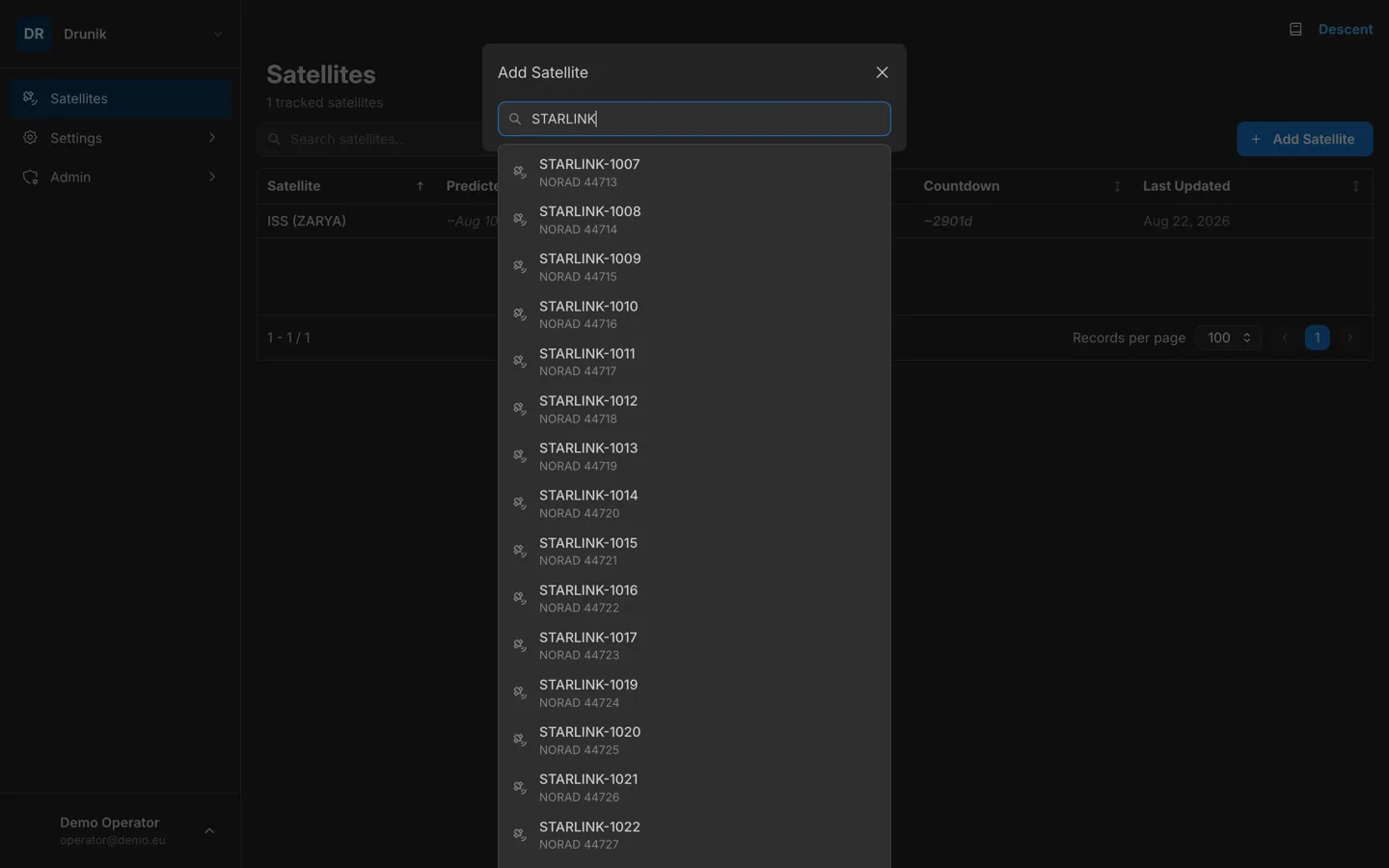
Descent tracking screen showing the Add Satellite catalog search with mission and NORAD results.
  • Satellite lookup by name or NORAD ID

    Add a spacecraft by the catalog handle your team already uses, whether that is a mission name or a NORAD catalog number.

  • Hourly TLE ingestion with five-year backfill

    The tracking record includes fresh general-perturbations (GP) orbital elements, the TLE sets that Space-Track and CelesTrak publish (CelesTrak also serves them as OMM), plus the historical TLE trail needed to understand how the prediction moved over time.

  • Automatic re-prediction on orbit change

    A new tracking update produces a new orbital lifetime forecast without analysts manually re-running the case.
Forecast outputs

A date, a countdown, and the context behind both.

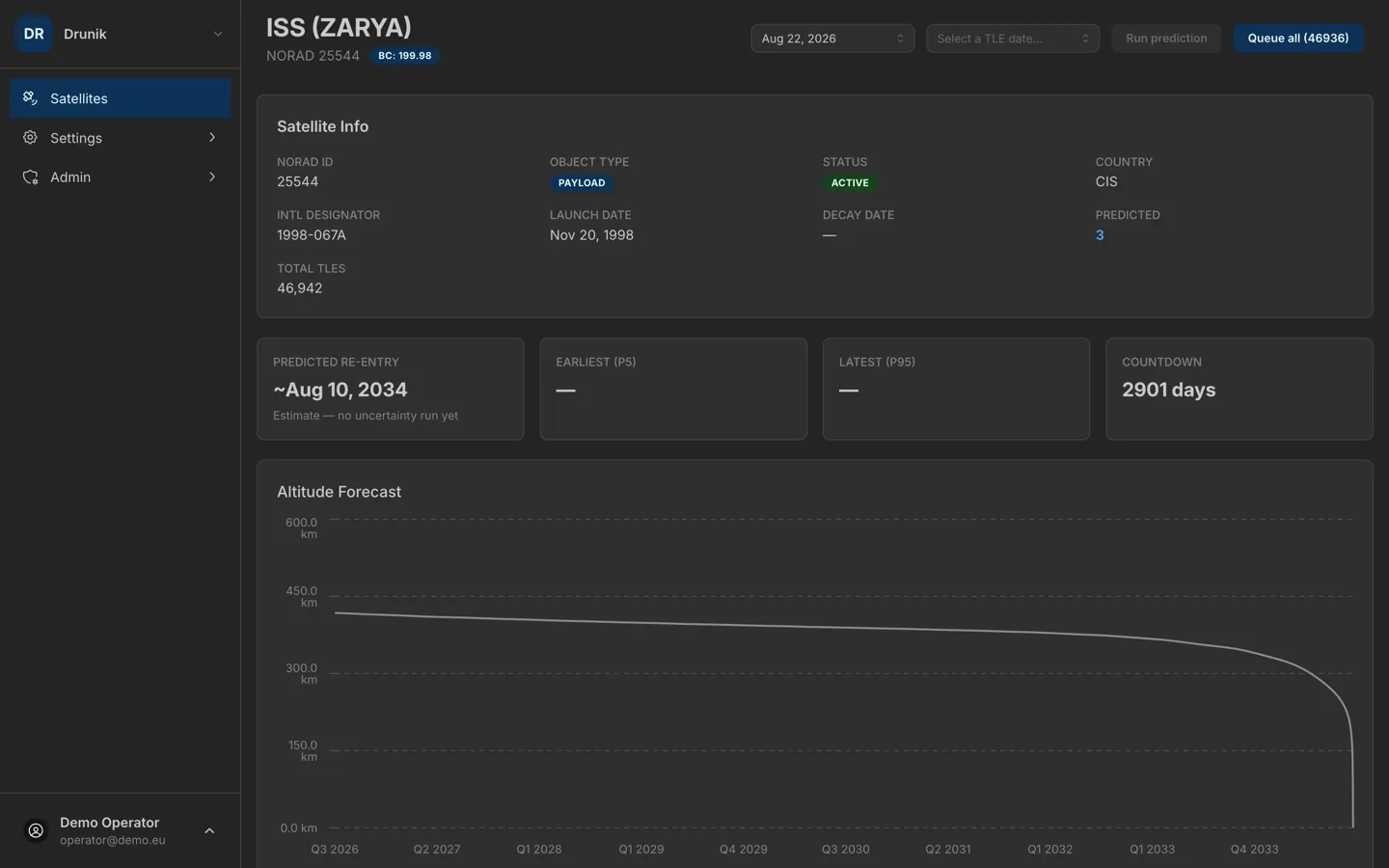
The prediction surface is opinionated around orbital lifetime, the re-entry date, and its traceability. Every output below is already part of the built product surface.

Descent forecasting screen showing prediction tiles with the altitude-decay forecast chart for a tracked satellite.
  • Predicted re-entry date with live countdown

    The primary output is the current predicted re-entry window (the decay date, in Space-Track terms), paired with a running countdown to the event.

  • Charts for orbital decay

    The satellite detail page includes an orbital decay forecast chart (altitude over time) and a ballistic-coefficient trend across predictions.

  • Append-only prediction history

    Every forecast update is retained in sequence, so the record shows what changed and when.

  • Per-prediction provenance

    Each prediction stores the TLE inputs, fetch timing, and engine version used to produce it.

Operations

Built for real teams, not single-user demos.

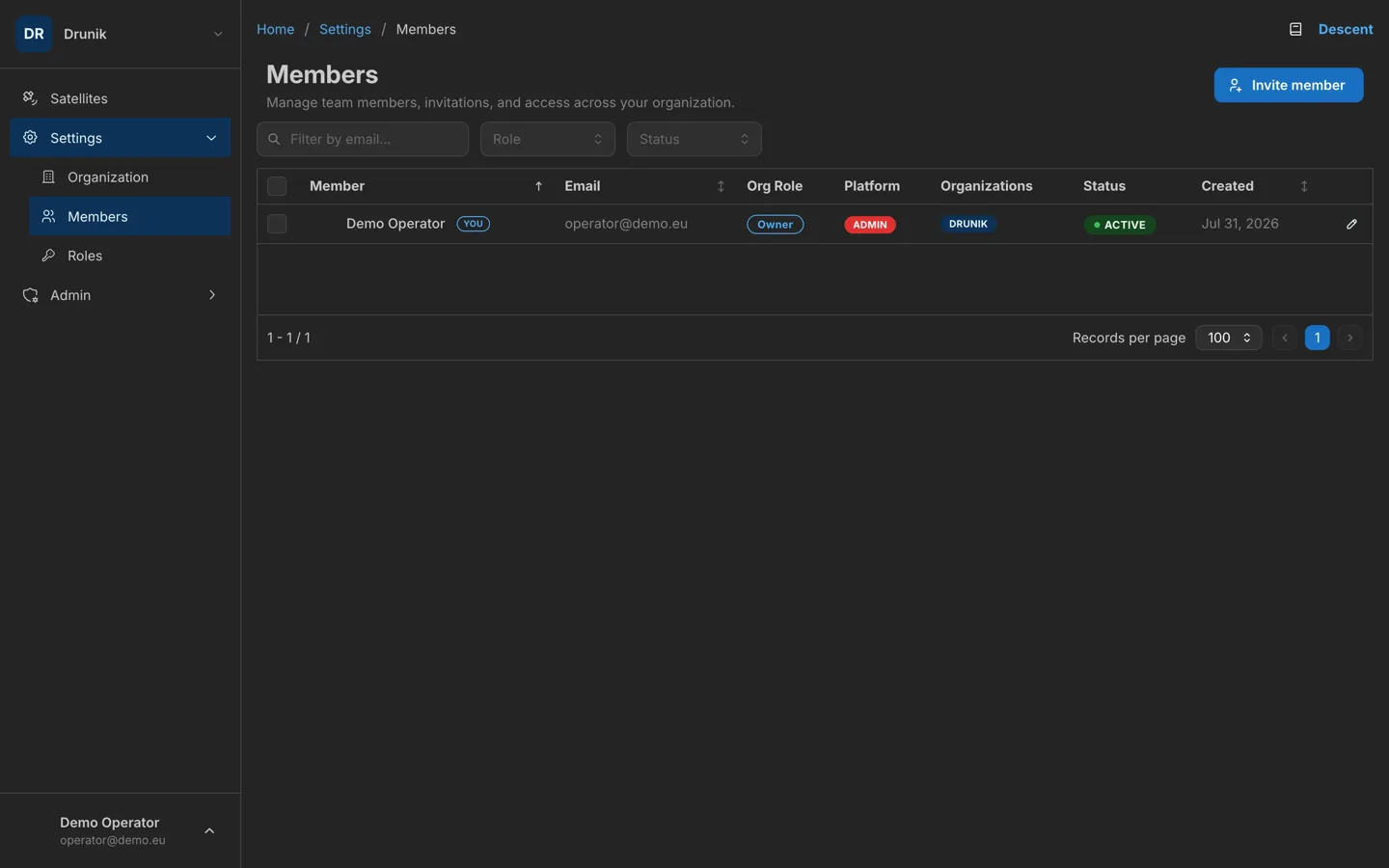
The current platform already includes the organization and governance basics needed to use the forecast record in shared workflows.

Descent operations screen showing organization members, roles, and access controls.
  • Space-weather modeling in the prediction engine

    Forecasts account for the environmental factors already modeled in the product rather than assuming a drag-only toy scenario.

  • Organizations, roles, SSO, and magic-link sign-in

    Access is organized at the team level, with authentication paths that fit both institutional and lightweight operator workflows.

  • Audit log

    Activity is recorded so teams can review who changed access and how the shared workspace evolved.

Private beta

If those are the workflows you need, request access.

The beta is aimed at teams that already need a current re-entry date, a history of how that date moved, and the tracking inputs behind it.

Confirm via email, then one message when your access is ready. No spam, unsubscribe anytime.